 +20 150 582 6016
 info@as-home-group.com
Can foreigners buy in Hurghada?
Can foreigners buy property in Hurghada? Yes — and it’s easier than you think. Discover Egypt’s property laws, ownership rules, residency options, costs, and step-by-step buying process in this 2026 guide.

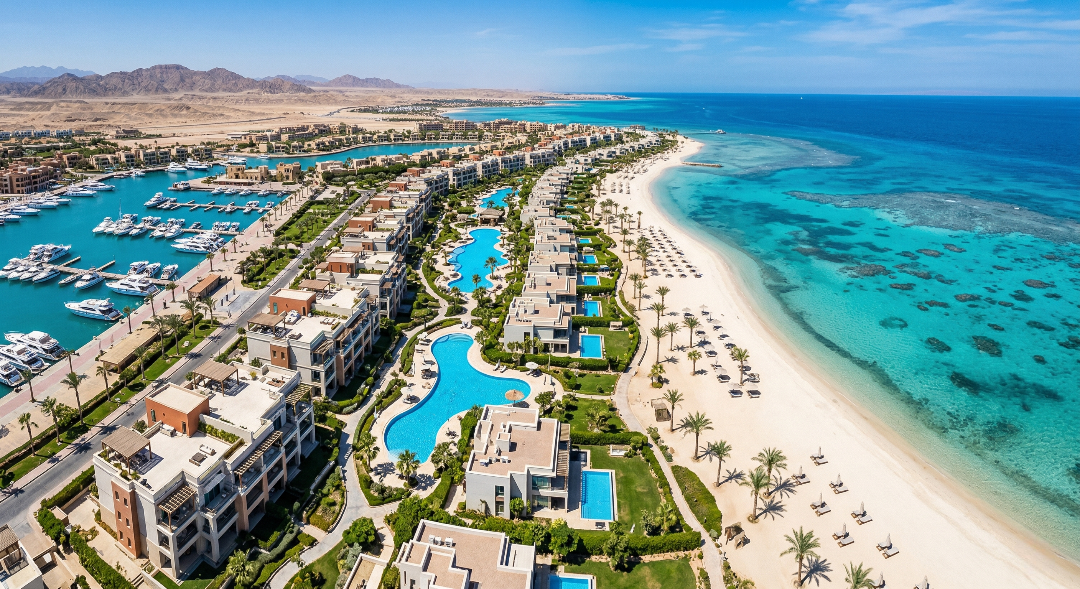
The short answer is yes - and it's more straightforward than most people expect. Here's everything you need to know.
📍Hurghada, Red Sea
⏱️ 10 min read
📅 Updated 2026
"Yes - foreigners can own full freehold property in Hurghada. Egypt's Red Sea coast is one of the most accessible property markets for international buyers in the region."
IN THIS GUIDE
01 The legal framework: what the law actually says
02 why Hurghada is a special case
03 Ownership rules every buyer must know
04 Residency: how property leads to a visa
05 Step-by-step: how the buying process works
06 Taxes and costs to budget for
07 Practical tips before you sign anything
The Legal Framework
Foreign property ownership in Egypt is governed primarily by Law No. 230 of 1996, which allows non-Egyptians to legally purchase residential real estate under defined conditions. This law has been meaningfully updated by Prime Ministerial decrees and amendments in 2023 and 2024, making the process more transparent and buyer-friendly than at any previous point.
A second key piece of legislation — Law No. 143 of 1981, the Desert Land Law — was amended in January 2024 to allow foreigners to fully own land for investment projects, lifting earlier restrictions that required majority Egyptian ownership in certain venture types.
Key legal update — 2024
From 2024, all foreign property payments must be processed through authorised Egyptian banks, and registration offices are required by regulation to refuse any sale to a foreigner unless foreign-currency transfer requirements are met. This change protects buyers and adds transparency to every transaction.
The legislation explicitly names Hurghada and the Red Sea coast as pre-approved zones for foreign freehold ownership. This means buyers here do not face the ambiguity that exists in some other parts of Egypt — the market has clear rules, a long track record of foreign transactions, and legal professionals experienced in guiding international buyers through the process.
Why Hurghada Is a Special Case
Not all of Egypt offers the same ownership conditions for foreigners. The Sinai Peninsula, for example, restricts foreign buyers to 99-year leaseholds rather than freehold ownership. Border zones and military-designated areas are off-limits entirely.
Hurghada is different. Prime Minister Resolution No. 548 of 2005 explicitly grants foreigners equal freehold rights to Egyptians in Hurghada and across the Red Sea governorate. Units purchased under this resolution are also exempt from the standard five-year resale restriction that applies in other parts of Egypt — meaning buyers can sell at any time after acquisition.
This makes Hurghada one of the cleanest, most investor-friendly markets on the Red Sea — and one of the reasons it consistently attracts buyers from the Gulf, Europe, and beyond. The city has decades of experience handling international property transactions, with a well-developed ecosystem of local lawyers, registered developers, and notary services familiar with foreign buyer requirements.
Ownership Rules Every Buyer Must Know
While the market is open and buyer-friendly, there are important conditions to understand before you commit to a purchase.
Under Law 230/1996, individual foreign buyers can own up to two residential properties in Egypt. This limit has been eased in some cases for buyers paying entirely in foreign currency from abroad.
Each property must not exceed 4,000 square metres. In practice, almost all residential units in Hurghada — apartments, chalets, and villas — fall well within this limit.
Purchase funds must be transferred from abroad through an authorised Egyptian bank. SWIFT receipts are required as proof of foreign-currency remittance — keep these documents carefully.
Agricultural land, properties classified as antiquities, and land within border or military zones cannot be purchased by foreigners. This does not affect standard residential developments in Hurghada.
If you purchase vacant land, Egyptian law requires construction to begin within five years. Failure to do so can result in penalties or the state reclaiming the land.
When buying off-plan, confirm that the developer holds the land title and that payment milestones are tied to construction progress. This is standard practice but worth verifying in writing.
Hurghada exception — resale
In most of Egypt, foreigners cannot sell property for five years from the registration date. In Hurghada and across the Red Sea zone, this restriction is lifted. You can sell at any point after purchase — a significant advantage for investors who may want to exit or reinvest on their own timeline.
Residency: How Property Leads to a Visa
One of the most compelling benefits of buying in Hurghada is Egypt's residency-by-property pathway. Foreign property owners can apply for a renewable residency permit — and the duration of that permit is directly tied to the value of the property and how the purchase was funded.
Residency is not automatic, but the process is structured and transparent. Payments must be made in foreign currency transferred from abroad (supported by bank SWIFT receipts) to qualify.
|
Entry tier 1 year Renewable permit |
Mid tier 3 years Renewable permit |
Premium tier 5 years Renewable permit |
The specific property value thresholds for each tier are set by the Egyptian government and subject to periodic revision. Consult a licensed local lawyer to get the current figures at the time of purchase. Residency granted through property ownership also extends to immediate family members in most cases.
Important note
Property ownership in Egypt can also be passed on to heirs. It is advisable to consult an estate lawyer and consider registering a local will to simplify any future transfers.
Step-by-Step: How the Buying Process Works
The process of buying property in Hurghada as a foreigner typically takes between two and four months from offer to registered ownership. Here is how it works in practice:
-
Search and shortlist
Browse listings, visit properties, and verify that each unit has clear title documents and no outstanding liens, debts, or ownership disputes. A reputable local agent or the developer's sales team can guide this stage.
-
Reservation agreement
Once you identify a property, a reservation agreement holds it while you review the full contract. A typical reservation deposit runs between $1,000–$5,000, which is credited toward the total purchase price. This step is optional but recommended in active markets.
-
Legal due diligence
Engage an independent licensed lawyer to review the property's title, check for any legal encumbrances, verify the developer's land registration (for off-plan), and review the bilingual sale contract. This step is non-negotiable.
-
Sign the sale contract
A bilingual contract (Arabic plus your preferred language) is signed. It must include the payment schedule, completion date, property description, and any agreed conditions. For resale properties, this is typically authenticated by an Egyptian court. For new developments, it is signed and authenticated by a Notary Public at the Real Estate Registration Office.
-
Transfer funds via authorised bank
All purchase funds must be transferred from abroad in foreign currency through an authorised Egyptian bank. Retain all SWIFT transfer receipts — these are required for registration and for any future residency application.
-
Registration at the Real Estate Registry (Tabu)
The sale contract is submitted to the local Real Estate Registry within 10 days of signing. The registry verifies the foreign-currency requirements and any required security clearances before finalising the title transfer. Registration typically takes two weeks to three months depending on the transaction type.
-
Apply for residency (optional)
Once registered, eligible buyers can apply for a renewable residency permit. Your lawyer can initiate this process using your proof of ownership and SWIFT receipts as the core documentation.
Taxes and Costs to Budget For
Beyond the property price itself, buyers should factor in a set of additional costs. These are broadly consistent across the Egyptian market and are not unusual compared to other international property markets.
| Cost | Approximate Amount | Notes |
|---|---|---|
| Registration fee | 2–3% of property value | Paid at the Real Estate Registry (Tabu) |
| Notary / documentation fees | Variable | Depends on transaction type and property value |
| Legal fees | 1–2% of property value | Independent lawyer; highly recommended |
| Agent commission | 2–3% (typically paid by seller) | Confirm arrangement in writing before proceeding |
| Annual property tax | Low; based on assessed rental value | Egypt's property tax rates are modest by international standards |
| Bank transfer fees | Varies by bank | Applicable on the inbound transfer to Egyptian bank |
Total transaction costs for a foreign buyer in Hurghada typically fall in the range of 5–7% of the purchase price on top of the property value — consistent with, and often lower than, equivalent costs in other Mediterranean and Red Sea markets.
Practical Tips Before You Sign Anything
Always engage an independent lawyer
Do not rely solely on the developer's legal team or the seller's agent. An independent, licensed Egyptian lawyer will verify title, check for encumbrances, review the contract in detail, and ensure the registration process is completed correctly. This cost is minimal relative to the value of a property transaction.
Verify the developer's land title first
For off-plan properties — which are common in Hurghada — confirm that the developer holds a clear registered title to the land before making any payments. Link your payment milestones to construction progress in the contract.
Keep every SWIFT receipt
Every foreign-currency transfer made as part of your purchase must be documented. These receipts are required for property registration and are the primary documentation for any future residency application. Store physical and digital copies.
Understand freehold vs. leasehold clearly
Hurghada offers full freehold ownership for foreigners. Be cautious of any arrangement described as a "99-year usufruct" in this area — that structure is appropriate in Sinai but is not the norm in the Red Sea governorate for standard residential purchases. Ask your lawyer to confirm the ownership structure explicitly before signing.
Watch out for
Estate agents in Egypt are not regulated the same way as in some Western countries. Always verify any agent you deal with through your independent lawyer, and do not rely on verbal commitments — everything material should be in the written contract.
Ready to start browsing?
View all properties for sale in Hurghada →
Find Your Property in Hurghada
Browse our curated listings of residential properties, vacation homes, and investment units across Hurghada — all verified and ready for international buyers.
المزيد من Buying & investing.
ROI on Vacation Rentals in Hurghada: Realistic Numbers
Discover real rental yields, occupancy rates, and income potential for Hurghada real estate in 2026. Data-driven insights on vacation rentals, seasonality, and ROI in Egypt’s Red Sea market.
The As-home team١١ أبريل ٢٠٢٦
Beyond the Red Sea: Why Hurghada is the Smartest Real Estate Investment in 2026
A comprehensive guide to investing in Hurghada real estate in 2026. Discover why the Red Sea offers Egypt's highest rental yields, how infrastructure is driving capital appreciation, and how to invest commission-free with As-home.
The As-home team١٩ يناير ٢٠٢٦
مصيف اسكندرية سبتمبر ٢٠٢٦: البحر لسه دافي والمدينة بتفضى
مصيف اسكندرية في سبتمبر ٢٠٢٦: حرارة البحر حوالي ٢٧ درجة، الزحمة بتقل بعد بداية الدراسة يوم ١٢ سبتمبر، وإزاي تحجز شقة موثقة بتأكيد فوري ودفع بالكارت.
The As-home team٢٦ يوليو ٢٠٢٦